The AI Remix Loop: How Platforms Replace Creators
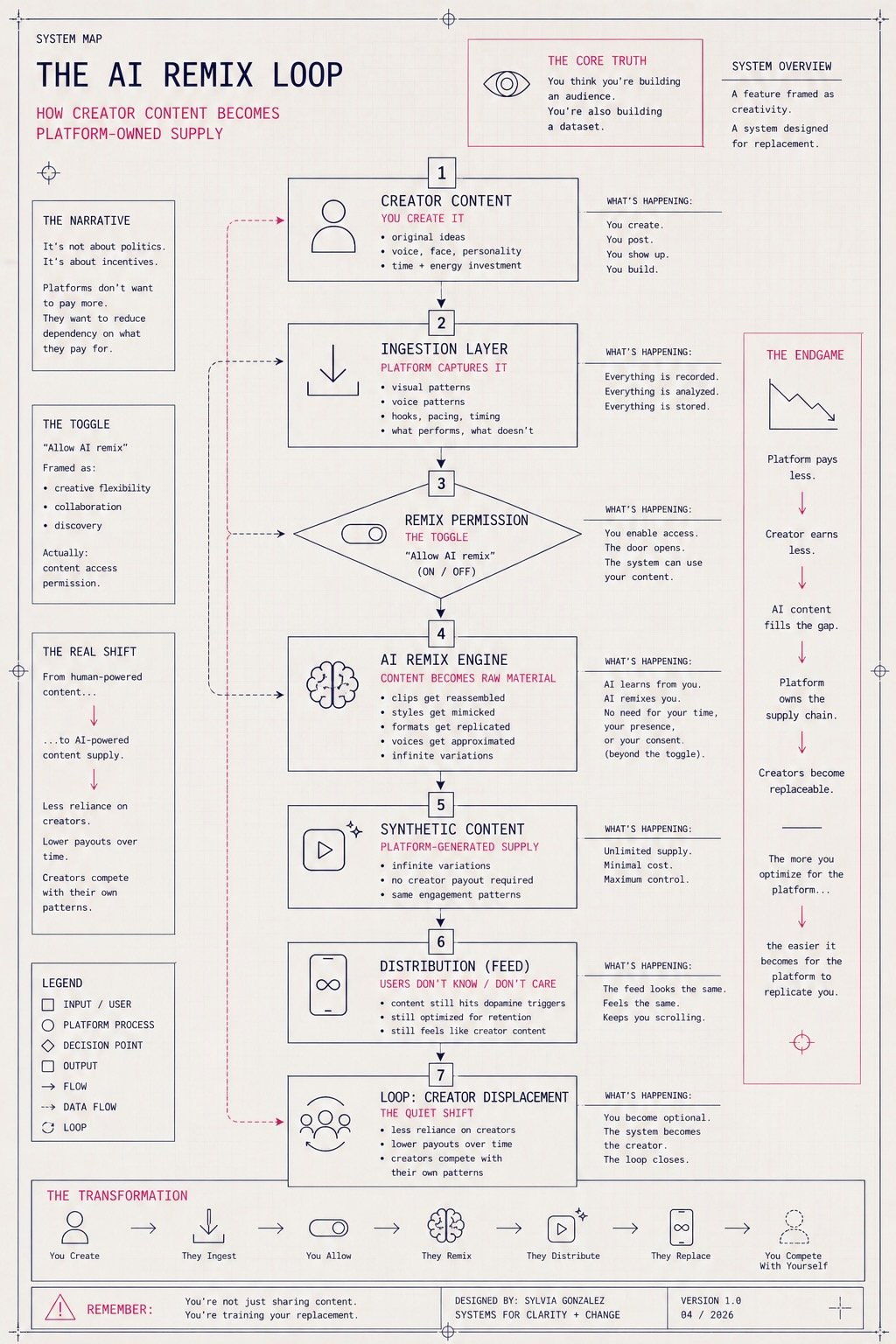
This piece breaks down the full lifecycle of creator content inside modern platforms—from creation to ingestion to AI replication.
What’s framed as a creative feature is actually a supply chain optimization system.
Your content isn’t just content, it’s training data.
And the more you optimize for the platform, the easier it becomes for the platform to replace you.
This diagram isn’t reactionary, it’s structural.
It shifts the conversation from surface-level outrage to underlying incentives.
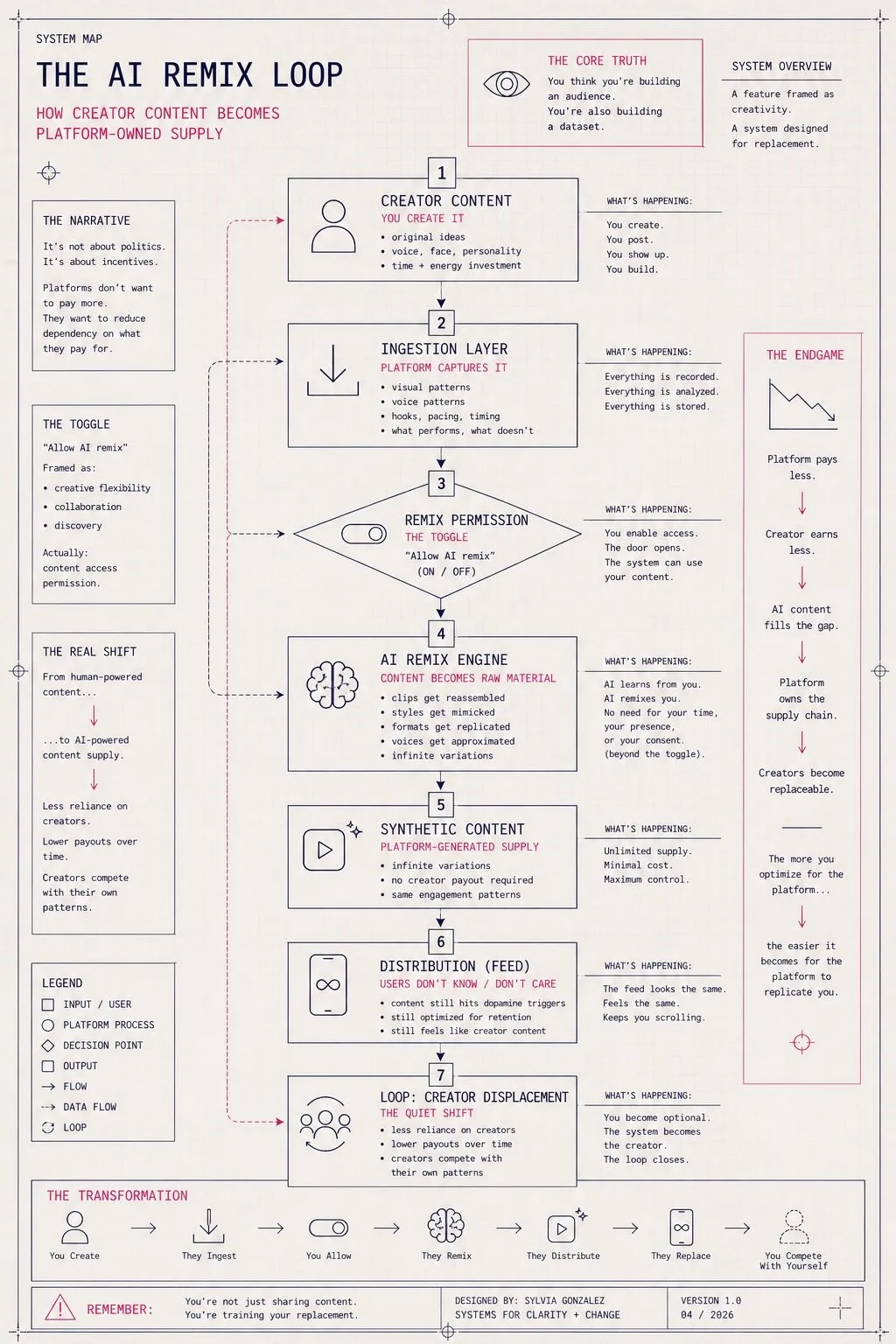
Part of what inspired me to put this diagram together was a YouTube video I watched from a creator who had experienced significant success on TikTok. She was discussing the many changes happening on the platform and explaining why so many creators—herself included—were either leaving or seriously considering it. A major point of frustration was TikTok's AI Remix feature and the broader impact AI seemed to be having on creators' livelihoods.
I watched the entire video, along with several others from creators expressing similar concerns. What struck me was that everyone seemed to be asking the same question:
"Why is TikTok doing this?"
They were genuinely puzzled.
From my perspective, standing outside the creator economy and looking in, the answer seemed fairly straightforward. Many of these same creators were also talking about declining payouts and reduced opportunities to earn income on the platform. If a company is under pressure to reduce costs, and a new technology emerges that allows content to be generated for free—or for a fraction of what human creators cost—the incentive becomes obvious.
In other words, I didn't see TikTok's AI Remix feature as a mysterious decision. I saw it as an economic one.
That doesn't mean I agree with it. It doesn't mean I think it's good for creators. But it did seem to answer the question of "why."
What fascinated me wasn't TikTok's decision itself. It was the fact that so many people looking at the exact same situation arrived at completely different explanations.
One creator whose video was shared during this discussion immediately blamed politics. His conclusion was essentially that these platform changes were happening because of Trump.
And that's when I realized I wasn't really watching a conversation about TikTok at all.
I was watching a demonstration of lenses.
We all wear them.
Some people view the world primarily through a political lens. Others through a technological lens. Others through a spiritual, economic, psychological, or cultural lens.
The lens itself isn't necessarily wrong. The problem is that once we're wearing it, we can begin seeing everything through it.
An economist looks at TikTok and sees incentives.
A technologist sees automation.
A politician sees power.
A creator sees fairness.
A psychologist sees behavior.
And often, we become so attached to our preferred lens that we forget we're wearing one.
This realization eventually led me to create this diagram.